How Auto Dealers Can Reduce Chargebacks and Buybacks With Better Income Verification
A chargeback or buyback doesn’t just cost the deal — it unwinds the entire transaction, damages your lender relationship, and hits your bottom line hard. Better income verification at the point of sale is the most direct way to prevent them.
For most dealers, chargebacks and buybacks sit in a separate mental category from the income verification process at the point of sale. The chargeback, if it comes, arrives weeks later — and it feels like a lender problem, or a fraud problem, or bad luck rather than a process problem.
But the connection is direct. The large majority of dealer chargebacks and lender-initiated buybacks trace back to one of two root causes: income misrepresentation that wasn’t caught at the point of sale, or a debt service capacity problem that existing verification processes didn’t surface. Both are solvable with better income verification. And for dealers operating on thin margins in a competitive market, the cost of not solving them is substantial.
What a Chargeback Actually Costs a Dealer
The face value of a chargeback — the dealer repaying the funded amount — is only the beginning of the cost. When a lender charges back a deal, the dealer typically loses the front-end gross on the vehicle sale, the F&I income on the deal, any dealer reserve on the finance contract, and any trade-in profit built into the transaction. In a deal structure where the total dealer income might be $3,000 to $5,000, a chargeback can eliminate it entirely and then require cash out of reserve on top.
Beyond the direct financial hit, chargebacks damage lender relationships in ways that compound over time. Lenders track chargeback rates by dealer. Dealers with elevated chargeback rates face increased scrutiny on submissions, slower funding timelines, tighter stipulation requirements, and in some cases programme termination. A single fraudulent deal that results in a chargeback doesn’t just cost that deal — it increases the cost of doing business on every deal that follows for months.
Early payment default (EPD) chargebacks — where a borrower misses their first or second payment — are particularly damaging because they occur quickly enough that the lender has essentially funded a fraud. EPD chargeback clauses in most dealer agreements give lenders broad recourse rights, and the income misrepresentation that causes EPD is exactly the type of fraud that better upfront verification prevents.
How Income Misrepresentation Creates Chargeback Risk
The pathway from income misrepresentation to chargeback is straightforward. A borrower inflates income on their application — by fabricating pay stubs, overstating employment, or misrepresenting gig earnings — the deal funds based on that inflated income, and the borrower defaults because they never had the actual repayment capacity the application suggested. The lender exercises its chargeback right against the dealer who submitted the deal.
This pathway is more common than most dealers want to acknowledge. According to Point Predictive’s research, income and employment misrepresentation accounted for $3.6–3.9 billion in auto lending fraud exposure in 2024, with 1 in 5 pay stubs submitted being forged. The fraud is often not detectable through standard document review — forged pay stubs have become sophisticated enough that visual inspection misses the fabrications. But it is detectable through transaction data. A borrower claiming $6,500 per month in income whose bank account shows $2,800 per month in deposits is a discrepancy that no fabricated document obscures when you’re reading the actual account.
Beyond outright fraud, there’s a larger category of income verification failures that don’t involve intentional misrepresentation but produce the same result. Borrowers who are technically employed but whose income has been declining, whose expenses have grown beyond their means, or who have undisclosed obligations not visible on the credit report all represent default risk that standard income verification doesn’t surface. Cash flow analysis catches these patterns because it’s measuring actual financial behaviour, not just what’s declared on the application.
A borrower claiming $6,500 per month whose bank account shows $2,800 in deposits is a discrepancy no fabricated document can hide when you’re reading the actual account. This is the verification gap that turns into a chargeback six weeks after funding.
The Lender Stipulation Problem
Many dealers experience lender stip requests as a friction point — additional documentation requirements that slow funding and create more back-and-forth. But lender stips around income verification exist precisely because lenders have learned, through chargeback experience, which income verification failures most commonly precede default. When a lender stips for additional bank statements or asks for a more recent pay stub, they’re trying to catch the same problem you’re trying to avoid.
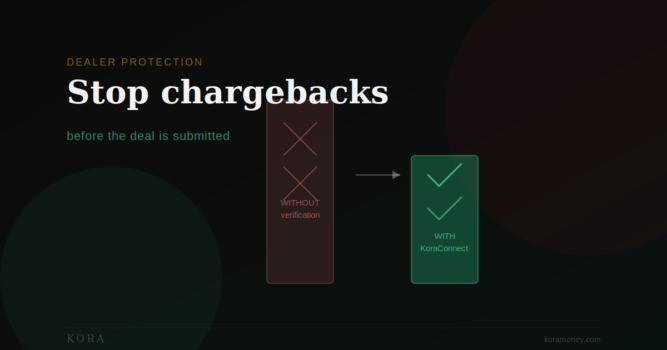
The better solution — for dealers and lenders both — is to verify income more thoroughly upfront, before submission, so that stipulations aren’t necessary. A deal submitted with a KoraConnect income verification report already attached gives the lender confidence that the income has been verified against actual transaction data. In practice, this means fewer stips on submission, faster funding decisions, and a stronger overall submission quality that lenders reward with preferential treatment over time.
For dealers working with lenders who use KoraConnect directly as part of their underwriting process, the integration is even more seamless: the income verification KoraConnect performs at the dealer level feeds directly into the lender’s underwriting workflow, eliminating duplicate verification and reducing the total time from application to funding.
What Better Income Verification Looks Like at the Dealership
A stronger income verification process at the dealership level has three components. The first is going beyond documents: instead of relying solely on pay stubs and employment verification calls — both of which can be fabricated or incomplete — using a tool that accesses borrower bank transaction data directly. This is what KoraConnect does: the borrower connects their bank account or uploads statements through the KoraConnect portal, and the platform analyses the transaction data to produce a verified income figure, a cash flow assessment, and a composite score.
The second component is consistency: applying the same verification process to every deal, not just the ones that feel risky. Income fraud rarely announces itself in advance. The deals that seem straightforward — the borrower who presents confidently, has a reasonable credit score, and produces clean-looking documentation — are often the ones where more sophisticated fabrication is at work. A consistent process applied to every deal eliminates the selection bias that leaves you exposed on the deals you were least worried about.
The third component is documentation of the verification for lender submission. KoraConnect produces a structured report that documents the income verification process and findings in a format lenders understand and trust. Submitting this report alongside the deal package communicates to the lender that you’ve done the work — and protects the dealer in the event of any subsequent dispute about the verification that was performed.
The Bottom Line on Chargeback Prevention
Chargebacks and buybacks are not an inevitable cost of doing business in auto retail. They’re a predictable consequence of income verification processes that weren’t built to catch the types of fraud and financial stress that actually cause default. Dealers who invest in better verification at the point of sale — using transaction data rather than documents, applied consistently across all deals — see meaningful reductions in chargeback rates and the downstream effects on lender relationships and deal economics.
KoraConnect gives dealers the verification tool that makes this possible: fast, direct bank data access, automated income analysis, and lender-ready output that reduces stips, speeds funding, and protects the dealer’s position from application through funding and beyond.
Tired of chargeback exposure?
See how KoraConnect helps dealers verify income at the source — before the deal is submitted.