Cashflow Underwriting: What Lenders Need to Know
For lenders, the challenge has always been the same: accurately assess risk while continuing to grow the portfolio.
Traditional underwriting—built around credit scores and static financial documents—still plays a critical role. But it also leaves gaps. Millions of otherwise creditworthy borrowers are excluded or mispriced because their financial reality doesn’t fit neatly into legacy models.
Cashflow underwriting is emerging as a powerful way to close that gap.
What Is Cashflow Underwriting (From a Lender’s Perspective)?
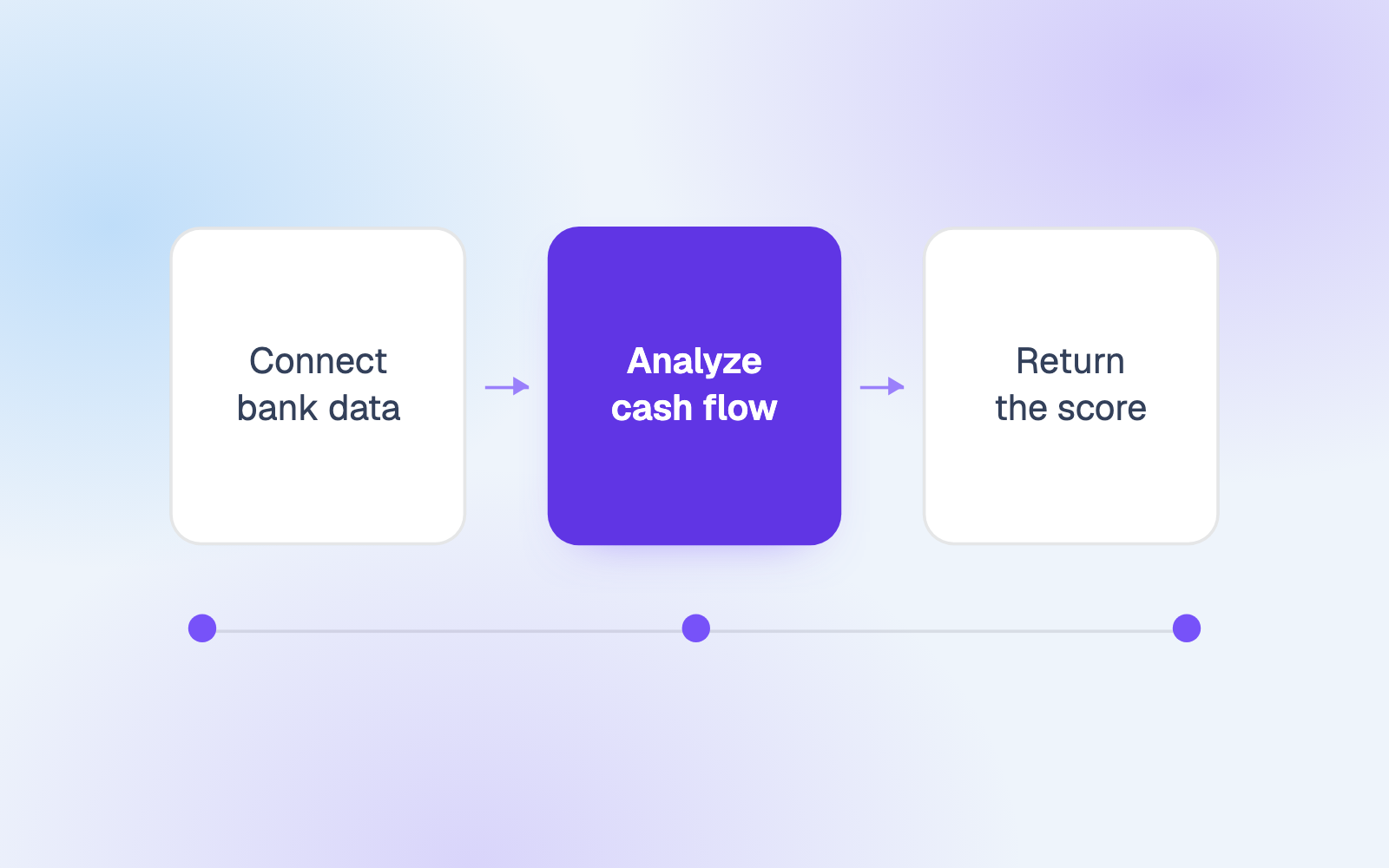
Cashflow underwriting evaluates a borrower’s ability to repay by analyzing real-time or recent bank account activity—income streams, expense behavior, liquidity, and balance trends.
Instead of relying primarily on historical credit data, it answers a more immediate question:
“Can this borrower afford this loan right now?”
Using infrastructure from providers like Plaid and Finicity or even directly uploading bank statements, lenders can access categorized transaction data and cashflow insights with borrower consent, often within seconds.
Why Lenders Are Adopting Cashflow Underwriting
1. Portfolio Expansion Without Proportional Risk Increase
Cashflow underwriting enables lenders to approve borrowers who may be declined under traditional models—thin-file, near-prime, or non-traditional earners—while still maintaining risk discipline.
This is particularly valuable in competitive origination environments where growth is constrained by rigid credit criteria.
2. Improved Risk Segmentation and Pricing
Transaction-level data allows for more granular segmentation:
- Income stability vs. volatility
- Fixed vs. discretionary spend
- Residual cashflow after obligations
- Early signs of financial stress (e.g., overdrafts, declining balances)
This can support more precise risk-based pricing and line assignment.
3. Enhanced Predictive Performance
Cashflow data provides forward-looking signals that credit bureau data often misses. For example:
- A borrower with a strong score but declining balances
- A thin-file borrower with highly stable income and surplus cashflow
Used correctly, this can improve model lift and reduce both Type I and Type II errors.
4. Faster Decisioning and Lower Operational Costs
Automated cashflow analysis reduces reliance on manual document review (bank statements, pay stubs), cutting:
- Underwriting time
- Verification costs
- Application friction
This is especially impactful in digital-first lending environments.
Where Cashflow Underwriting Is Driving Impact
Leading lenders and fintechs are already using alternative data strategies to:
- Increase approval rates
- Maintain or improve loss performance
- Serve underserved borrower segments
Common high-impact use cases include:
- Personal loans (prime and near-prime expansion)
- Small business and self-employed borrower evaluation
- Rental and deposit underwriting
- Line increases and account management strategies
What should you consider before implementation and how can we help?
Data Quality and Coverage
Not all cashflow data is equal. Gaps can exist due to:
- Unlinked accounts
- Cash-based income
- Incomplete transaction histories
Lenders should evaluate aggregation coverage and normalization accuracy when selecting providers, at Kora we aim to cover all consumer accounts so the gap is as small as possible.
Model Integration Strategy
Cashflow data can be used in multiple ways:
- As a standalone underwriting layer
- As a supplement to bureau-based models
- Within hybrid or AI-driven decision frameworks
The right approach depends on risk appetite and regulatory posture. We have a standard model available at the ready but can also customize the approach to tailor your needs.
The Strategic Opportunity
Cashflow underwriting is not just a tactical enhancement—it’s a structural shift in how credit risk can be assessed.
For lenders, the upside is clear:
- Expand addressable market
- Improve risk visibility
- Increase speed to decision
- Compete more effectively with digital-first entrants
As open banking adoption grows and data access improves, cashflow underwriting will likely become a core component of modern credit strategy—not just an edge case.
In summary, lenders that adopt will outpace the competition
Lenders that successfully integrate cashflow underwriting aren’t replacing traditional models—they’re augmenting them.
The result is a more complete view of the borrower, better risk decisions, and a meaningful opportunity to grow without compromising credit quality.


