How to Reduce Loan Default Rates Using Cash Flow Data
Default rates are rising across the industry. Here’s the data on why — and the evidence-backed case for cash flow underwriting as the most effective intervention available.
Loan default rates are a lagging indicator. By the time they rise in your portfolio, the lending decisions that caused them are already months or years in the past. The borrowers who defaulted were approved under a model that didn’t have enough information to see the risk clearly. That’s the fundamental challenge — and the fundamental opportunity — that cash flow underwriting addresses.
The Default Rate Problem Is Getting Worse, Not Better
The average business loan default rate across all US lender types is approximately 7.5% as of 2024–2025. FDIC data confirmed that the share of commercial banks reporting elevated small business loan delinquencies reached 28% in mid-2024, compared to 11% in 2022 — a more than doubling in two years. For consumer lending, the Federal Reserve’s 2024 household survey found that gig workers were less likely than traditional workers to have paid all their bills in the prior month, to have three months of emergency savings, or to be doing better financially than a year ago — exactly the population that traditional underwriting models struggle to evaluate accurately.
The common thread in rising default rates: lenders are approving borrowers based on a credit profile that doesn’t reflect their actual current financial situation. Cash flow data does.
Why Credit Scores Underpredict Default in the Current Environment
Credit scores are backward-looking and slow to update. A borrower who lost a major client six months ago, whose income has dropped 40%, and who is burning through savings to stay current on existing obligations can still have an excellent credit score — right up until they can’t. Cash flow data, by contrast, is real-time. NBER research examining cash flow data in consumer lending found that measures of financial health like more deposit inflows are associated with lower default probability, while measures of financial distress like overdrafts predict default — and these signals show up in transaction data before they show up in credit files, sometimes months earlier.
A borrower whose income dropped significantly six months ago can still have an excellent credit score. Cash flow data shows the deterioration in real time. That’s the gap between what credit scores measure and what actually predicts default — and it’s wider than most lenders realise.
The Four Mechanisms: How Cash Flow Data Reduces Default
Better Income Verification
When you verify income through actual transaction data rather than documents, you approve loans based on what borrowers actually earn, not what they claim to earn. Income and employment misrepresentation in auto lending alone accounted for $3.6–3.9 billion in fraud exposure in 2024. Loans approved on inflated income are structurally set up to default — the borrower never had the repayment capacity the application suggested. Eliminating income fraud at the application stage removes a substantial portion of future defaults before they happen.
Debt Service Coverage Based on Actual Obligations
Traditional DTI ratios are calculated from stated income and credit-bureau-reported obligations — both of which can be incomplete. Cash flow data calculates effective debt service coverage from the transaction record: actual recurring outflows relative to actual recurring inflows. This produces a materially more accurate picture of whether the borrower can service the proposed loan.
Early Warning Signals
Cash flow underwriting identifies borrowers already showing early signs of financial stress at the application stage. Chronic overdrafts, declining average balances, growing reliance on short-term credit products, or decreasing income over the past several months all appear in transaction data — and predict default even when the credit score hasn’t yet reflected the underlying deterioration.
Better Calibration for Non-Traditional Borrowers
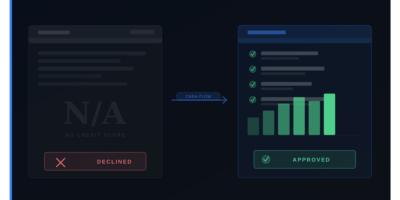
Traditional credit score models were calibrated primarily on borrowers with W-2 employment histories. They systematically over-predict default for thin-file borrowers who haven’t borrowed before — and who often perform well when they do. Cash flow data provides an independent, behaviour-based calibration that doesn’t inherit the biases of the credit scoring system.
The Evidence: What Lenders Actually See
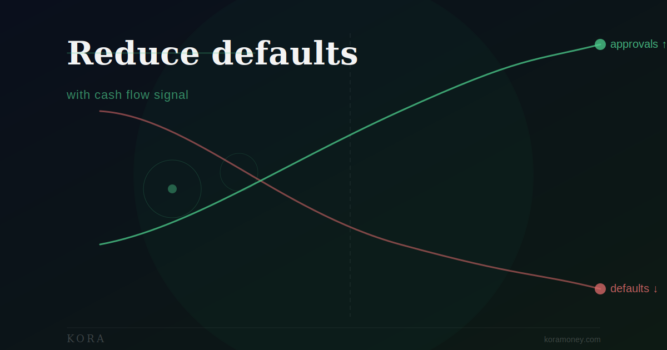
Prism Data Technologies’ consortium research — drawn from loan performance data across multiple lenders and loan types — showed that cash flow assessment can rank-order default probability consistently and independently across all credit score segments, from subprime to super-prime. Practically, lenders who implement cash flow underwriting typically see two portfolio metrics improve simultaneously: approval rates go up because they’re correctly identifying creditworthy borrowers that credit-only models decline, and default rates go down because they’re correctly identifying risky borrowers that credit-only models approve.
Building a Default Reduction Strategy Around Cash Flow Data
Three components: first, deploy cash flow assessment on all new applications — not just edge cases. Second, establish clear cash flow thresholds for key risk signals: minimum average daily balance, maximum overdraft frequency, minimum income consistency score, maximum month-over-month income decline, calibrated against your own loan performance data. Third, use cash flow data for portfolio monitoring as well as origination — many signals that predict default at application are also measurable in existing borrower accounts, giving you earlier warning on developing problems.
Where Kora Fits
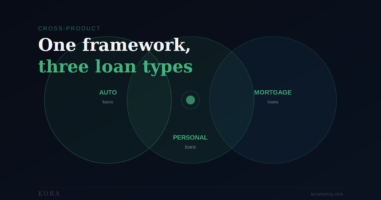
The Kora Score is built specifically to reduce default rates by surfacing the transaction-level signals that predict loan performance most reliably. Our models are trained and validated against real loan performance data across multiple loan types, and the score is calibrated to the outcome that matters: probability of repayment. The Kora Score integrates directly with your loan origination system, provides a clear default-risk signal on every application, and generates FCRA-compliant adverse action documentation.
Ready to bring your default rates down?
See how the Kora Score identifies the risk signals your current model is missing.